Innovation Lab

Engineering the Future of Thermal Intelligence

We invest over 8% of revenue in R&D. Our focus: making every watt of cooling smarter, cleaner, and more autonomous through AI, IoT, and advanced refrigerant chemistry.

Discuss Your Project
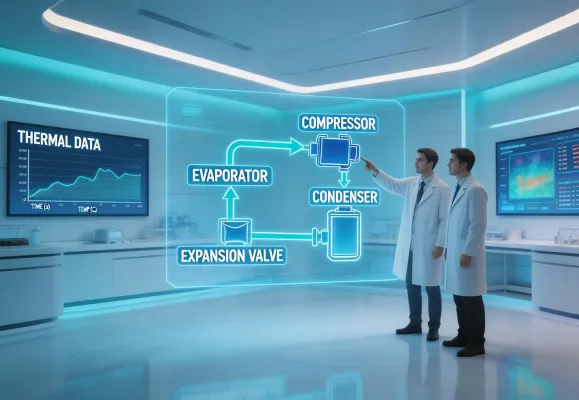
HitachiCool innovation lab and R&D facility

Four Pillars of Innovation

Our technology roadmap is built on four converging frontiers that will define the next decade of thermal management.

01

AI-Driven Predictive Analytics

Launched in 2021 and refined through three major model iterations (v1.0, v2.0 in 2023, v3.1 in 2025), our machine learning platform processes millions of data points from compressor vibration, superheat delta-T, and power harmonics to forecast mechanical failures 48-72 hours before they occur. Neural network accuracy on the v3.1 model exceeds 94% on validated failure modes across screw and scroll compressor platforms, verified against 18 months of field data from 4,800 connected units.

  • Vibration spectrum analysis at 10 kHz sampling rate
  • Automated COP degradation trending and alerting
  • Integration with ServiceNow, SAP PM, and Maximo
02

Next-Gen Refrigerant Platforms

Developed since 2020 and commercially deployed from 2022, our transcritical CO2 (R-744) systems operate efficiently even at ambient temperatures above 40 C thanks to gas cooler optimization and parallel compression architecture. For smaller capacities (below 100 kW), we offer R-290 propane platforms with integrated semiconductor leak detection meeting EN 378:2016 Class A3 requirements, available since 2023.

  • Transcritical CO2 with ejector recovery achieving COP 3.8 at 35 C ambient
  • R-290 charge-minimized designs below 150g per circuit
  • Full lifecycle GWP analysis tools for regulatory compliance
03

Digital Twin & Cloud Platform

Every connected HitachiCool system generates a real-time digital twin in our cloud infrastructure. Facility managers monitor multi-site portfolios, benchmark energy consumption against ASHRAE 90.1 baselines, and run what-if simulations for capacity expansion without physical prototyping.

  • REST API for BMS, SCADA, and ERP integration
  • Edge computing gateways with 5ms local response time
  • ISO 27001 certified data infrastructure
04

Variable Speed Compressor Design

Introduced in 2024, our 5th-generation inverter-driven compressor platform features rare-earth-free synchronous reluctance motors with wide turndown ratios (10:1 on screw, 15:1 on scroll). Soft-start algorithms reduce peak inrush current to 1.5x rated versus 6-8x on direct-on-line starters, extending bearing life by approximately 30% based on accelerated life testing conducted per ISO 15243:2017.

  • IPLV below 0.45 kW/TR on water-cooled chiller applications
  • Harmonic distortion below 5% THD with active front-end drives
  • Oil-free magnetic bearing options for critical cleanroom environments

Inverter vs. Fixed-Speed: The Performance Gap

Real-world data from 2,400+ installations demonstrates the efficiency advantage of variable-speed compressor technology across load profiles.

Inverter-Driven Systems

Parameter Value
Full Load COP5.2 - 5.8
IPLV (kW/TR)0.38 - 0.45
Part Load Energy Savings30-50%
Sound Level (1m)62-68 dB(A)

Fixed-Speed Baseline

Parameter Value
Full Load COP2.8 - 3.5
IPLV (kW/TR)0.62 - 0.75
Part Load Energy SavingsN/A
Sound Level (1m)72-78 dB(A)

Technology Applicability & Known Limitations

Transparent engineering means acknowledging where our technology excels and where constraints exist.

Our predictive maintenance models require a minimum of 90 days of continuous operational data before generating reliable failure predictions. The 94% accuracy rate applies to validated failure modes on screw and scroll compressors with sensor packages installed since 2022. Systems operating outside the training data envelope (ambient temperatures below -20 C or above 50 C, non-standard refrigerant blends, or heavily modified control logic) may produce higher false-positive rates. The AI platform does not replace scheduled preventive maintenance; it supplements it by prioritizing inspection targets.

While our transcritical CO2 systems with ejector recovery achieve COP 3.8 at 35 C ambient, performance degrades at higher ambient temperatures. At 45 C ambient, COP drops to approximately 2.6, making transcritical CO2 less competitive than R-290 or HFO-based systems in consistently hot climates (average annual temperature above 30 C). Operating pressures reach 120 bar on the high side, requiring specialized high-pressure-rated components, certified welding procedures, and technicians trained on high-pressure CO2 safety per EN 378-1:2016.

Variable frequency drives introduce harmonic distortion into the electrical supply. While our active front-end drives maintain THD below 5%, facilities with sensitive electronic equipment or weak electrical infrastructure may require harmonic filters or isolation transformers. VFD-driven compressors also need minimum cable shielding specifications (screened cables with 360-degree ground termination) and dedicated grounding to prevent bearing current damage. These installation requirements add approximately 8-12% to the electrical installation cost compared to fixed-speed equivalents.

By the Numbers

120+ Patents Filed
8.4% Revenue in R&D
340 Engineers Worldwide
3 Global R&D Centers

Partner With Our Innovation Team

From concept validation to field deployment, our engineers collaborate with OEMs, system integrators, and end users to co-develop thermal solutions.

Start a Technical Discussion